The 13 fault code systems explained
Each system below is laid out the same way. Plain-English explanation first. Then what you might notice as a driver, common causes, and what to do. Then mechanic-grade detail and the MOT linkage data.
Glow plugs (diesel cold-start)
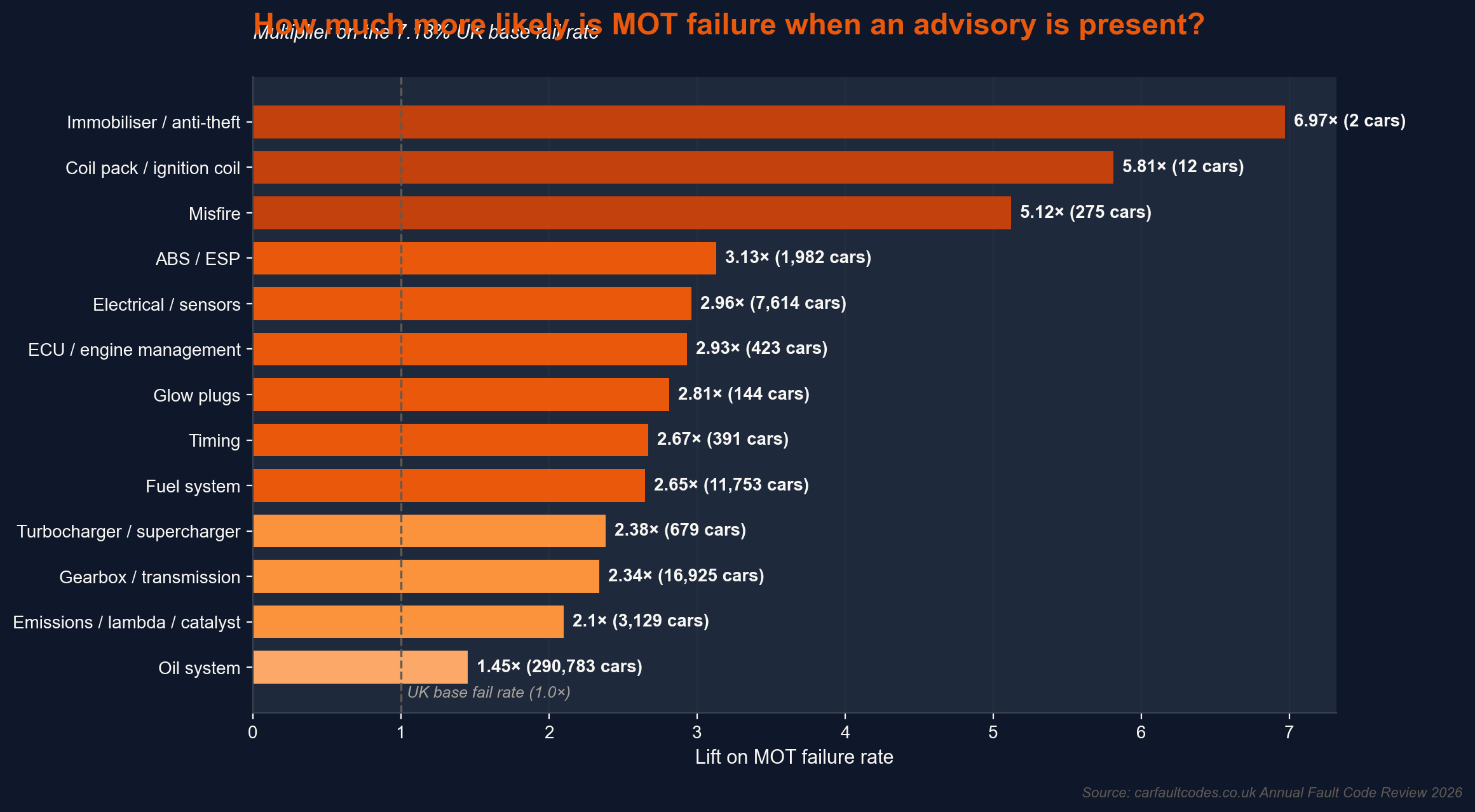
Six failures in 1.8 million cars. Whatever the winter forums say, glow plugs are a cold-start nuisance rather than an MOT problem. Fix them because you're sick of the long cranking, not because of the test.
In plain English
Glow plugs are small heaters that warm up the inside of a diesel engine's cylinders before you turn the key on a cold morning. Without them, a cold diesel will struggle to fire. Petrol cars do not have them.
What you might notice as a driver
You will know it when you turn the key on a frosty morning and the engine cranks but takes ages to start, or coughs out a cloud of white smoke before catching. The dashboard symbol is a coiled spring (sometimes with three dashes). If it stays on after start-up, flashes, or comes on while driving, the system has logged a fault.
Common causes
On most diesels, glow plugs wear out around 60,000 to 80,000 miles. They fail one at a time, so a single dead plug will trigger a code without stopping the car running. The relay or control module that powers the plugs can also fail. Wiring corrodes (the plugs sit in a hot, dirty part of the engine bay).
What to do about it
A failing glow plug system will not strand you in summer. In winter, it makes cold starts increasingly difficult and dumps unburnt fuel into the exhaust, which damages the DPF over time. Get it diagnosed before the cold weather arrives.
Mechanic-grade notes
Test each plug at the connector with a multimeter (most are 5–6 volts, draw 8–15 amps). Resistance under 1 ohm is typical when good. A common pitfall on Ford 1.8 TDCi and VAG 2.0 TDI is the plugs seizing in the head — soak in penetrating oil for 24 hours before extraction, and budget for a snapped plug specialist if luck runs out.
MOT relevance
Glow plug faults rarely cause a direct MOT failure on their own. They often appear as advisory items ("glow plug light on dash"), but if the engine warning light stays on as a result, that is a direct fail.
The fault codes in this system
| Total codes | 98 |
| Generic SAE codes | 68 |
| Manufacturer-specific | 30 |
| Code letter mix | P: 98 |
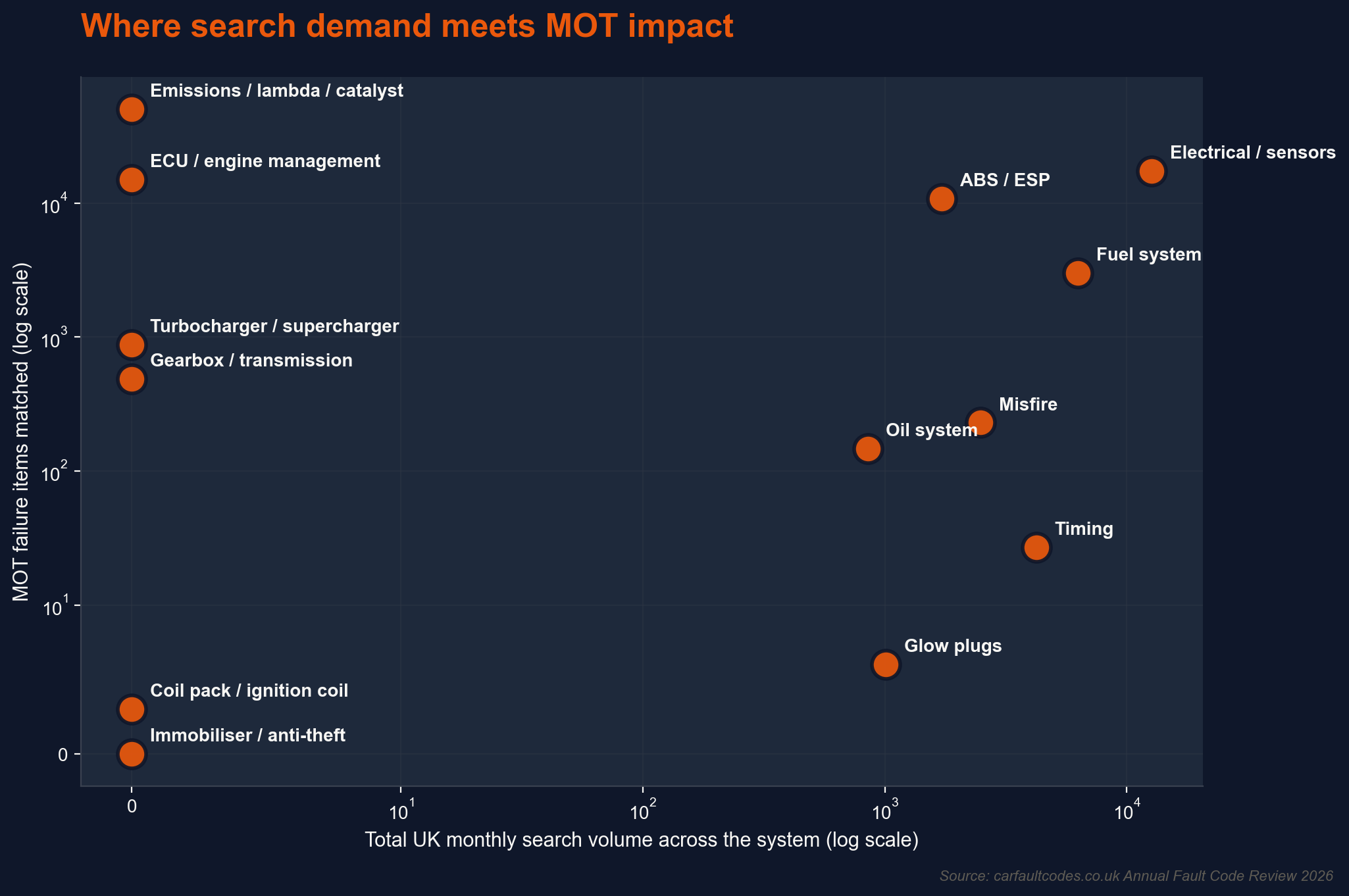
| UK monthly search volume | 1,010 |
| Global monthly search volume | 34,920 |
How this system shows up in MOT data
| MOT failure items matched | 6 |
| MOT advisory items matched | 144 |
| Vehicles with ≥1 advisory | 144 |
| Vehicles with ≥1 failure | 6 |
When an advisory is present, the next MOT
vs UK base of 7.18%
2.81× lift
Most-searched codes in this system
| Code | What it means | Generic? | UK / mo | Global / mo |
| P0380 | Glow Plug/Heater Circuit 'A' Malfunction | Yes | 450 | 7,600 |
| P0672 | Cylinder 2 Glow Plug Circuit Malfunction | Yes | 90 | 1,400 |
| P0671 | Cylinder 1 Glow Plug Circuit Malfunction | Yes | 80 | 1,600 |
| P0673 | Cylinder 3 Glow Plug Circuit Malfunction | Yes | 80 | 1,400 |
| P0674 | Cylinder 4 Glow Plug Circuit Malfunction | Yes | 70 | 1,300 |
| P1135 | A/F Sensor Heater Circuit Malfunction (Only for California Spec.) | No | 30 | 3,700 |
| P0670 | Glow Plug Control Module Circuit Malfunction | Yes | 30 | 2,300 |
| P0683 | Glow Plug Control Module to PCM Communication Circuit | Yes | 30 | 1,600 |
Top MOT failure descriptions (verbatim)
| 1 | Electrical wiring insecure and connectors likely to become disconnected glow plug relay |
| 1 | Engine MIL inoperative or indicates a malfunction eml, dpf and glow plug warning lamps illuminated |
| 1 | Engine MIL inoperative or indicates a malfunction dpf light on and glow plug flashing |
| 1 | Engine MIL inoperative or indicates a malfunction Glow plug light illuminated aswel |
| 1 | Engine MIL inoperative or indicates a malfunction Glow plug light on flashing as well. |
| 1 | Emissions unable to be completed Glow plug light flashing, coolant level and oil level low. Last record of cambelt replacement 07/10/14 at 126315 miles. |
Top MOT advisory descriptions (verbatim)
| 21 | glow plug light flashing |
| 15 | glow plug light on |
| 6 | glow plug warning light on |
| 6 | glow plug light on dash |
| 6 | Glow plug light flashing |
| 4 | glow plug light illuminated |
Coil pack / ignition coil (petrol ignition)
That 5.81x lift looks alarming until you notice it comes from twelve cars. What the number really says: by the time a coil fault gets written on an MOT sheet, the car is already running badly enough to fail on emissions anyway.
In plain English
Coil packs (sometimes called ignition coils) sit on top of the spark plugs on petrol engines and turn battery voltage into the high-voltage spark that fires the fuel. Modern petrol cars have one coil per cylinder. Diesels do not have them.
What you might notice as a driver
A failing coil shows up as the engine running rough at idle, like the car has caught a chest infection. Acceleration feels lumpy. The engine warning light comes on, often flashing, which means an active misfire. Fuel economy drops noticeably in a single tank.
Common causes
A single coil fails, usually on a high-mileage petrol. Spark plugs at the end of their life. Heat and oil around the coil cooking the insulation. Damp ingress on cars left standing.
What to do about it
A flashing engine warning light is urgent. It usually means an active misfire, and unburnt fuel pouring into the catalytic converter will destroy it within tens of miles. Slow down, avoid hard acceleration, and book a diagnostic scan today.
Mechanic-grade notes
Coils are cheap (£15–£60 each genuine, less for aftermarket) and easy to swap. Quick diagnostic: read the misfire code, swap the suspect coil to a different cylinder, scan again. If the misfire follows the coil, you have your answer. On VAG 1.4 TSI and BMW N20, plan to do all four at once given how close they tend to fail to each other. Always replace plugs at the same time.
MOT relevance
A flashing engine warning light caused by a misfire fails the MOT. Coil-pack-related issues also show up as emissions failures because of the catalyst damage they cause.
The fault codes in this system
| Total codes | 150 |
| Generic SAE codes | 14 |
| Manufacturer-specific | 136 |
| Code letter mix | P: 150 |
How this system shows up in MOT data
| MOT failure items matched | 3 |
| MOT advisory items matched | 12 |
| Vehicles with ≥1 advisory | 12 |
| Vehicles with ≥1 failure | 3 |
When an advisory is present, the next MOT
vs UK base of 7.18%
5.81× lift
Top MOT failure descriptions (verbatim)
| 1 | Oil leaking excessively from engine serious oil leak from the top around spark plugs /rocker cover area |
| 1 | Emissions unable to be completed CYL. 2 SPARK PLUG LOOSE |
| 1 | Electrical wiring insulation in such a condition there is an imminent risk of fire or formation of sparks Spark Plug Leads |
Top MOT advisory descriptions (verbatim)
| 3 | coil pack loose |
| 2 | no 4 spark plug looks loose |
| 1 | core plugs leaking on to spark plugs |
| 1 | coolant leak under coil pack |
| 1 | spark plugs loose in cylinder head |
| 1 | Cylinder 1 ignition coil is loose |
The first two systems are small beer in MOT terms. This next one is not.
Misfire (engine cylinder firing faults)
This one I take seriously. 275 cars carried a misfire advisory and they still failed at five times the national rate. A flashing engine light is worse than the numbers suggest: that's a catalytic converter being cooked in real time.
In plain English
A misfire is when one of your cylinders does not fire properly when it should. The car still drives, but you can feel and hear that something is off.
What you might notice as a driver
Engine shaking at idle is the giveaway. Steering wheel vibration with the car stationary in gear at the lights. Hesitation when you put your foot down. A flashing engine warning light. Sometimes a smell of unburnt petrol from the exhaust.
Common causes
Coil packs (most common on modern petrols). Worn or fouled spark plugs. A clogged fuel injector. Low compression in one cylinder, which is more serious. A vacuum leak. On older diesels, an injector problem will produce similar codes.
What to do about it
A misfire that comes on while you are driving means stop somewhere safe, turn the car off, and call for help. Driving on with a flashing engine warning light usually means a £300+ catalytic converter on top of whatever caused the misfire.
Mechanic-grade notes
P0300 = random/multiple cylinder. P0301-P0312 = specific cylinder identified. Always check fuel trim alongside misfire codes. A misfire under load with positive long-term fuel trim points to fuelling, not ignition. On Ford EcoBoost 1.0 and 1.6, misfires often trace to the injector or the wet timing belt rather than coils. Compression test essential before condemning anything expensive.
MOT relevance
Misfire-driven emissions failures are common (50,246 emissions failure items in our dataset). The physical cylinder problem itself does not fail the MOT directly, but the consequences (warning light, emissions, smoke) almost always do.
The fault codes in this system
| Total codes | 73 |
| Generic SAE codes | 26 |
| Manufacturer-specific | 47 |
| Code letter mix | P: 73 |
| UK monthly search volume | 2,490 |
| Global monthly search volume | 242,090 |
How this system shows up in MOT data
| MOT failure items matched | 230 |
| MOT advisory items matched | 277 |
| Vehicles with ≥1 advisory | 275 |
| Vehicles with ≥1 failure | 222 |
When an advisory is present, the next MOT
vs UK base of 7.18%
5.12× lift
Most-searched codes in this system
| Code | What it means | Generic? | UK / mo | Global / mo |
| P0300 | Random/Multiple Cylinder Misfire Detected | Yes | 600 | 69,000 |
| P0301 | Cylinder 1 Misfire Detected | Yes | 350 | 29,000 |
| P0302 | Cylinder 2 Misfire Detected | Yes | 300 | 22,000 |
| P0304 | Cylinder 4 Misfire Detected | Yes | 300 | 21,000 |
| P0303 | Cylinder 3 Misfire Detected | Yes | 250 | 21,000 |
| P0322 | Ignition/Distributor Engine Speed Input Circuit Low | Yes | 90 | 3,400 |
| P1336 | Crankshaft Speed Fluctuation Sensor Circuit Malfunction | No | 60 | 2,100 |
| P0325 | Knock Sensor 1 Circuit Malfunction (Bank 1 or Single Sensor) | Yes | 50 | 11,000 |
Top MOT failure descriptions (verbatim)
| 17 | Emissions unable to be completed engine misfire |
| 14 | Emissions unable to be completed misfire |
| 13 | Emissions not tested engine misfire |
| 8 | Emissions unable to be completed due to engine misfire |
| 6 | Emissions not tested misfire |
| 6 | Emissions unable to be completed due to misfire |
Top MOT advisory descriptions (verbatim)
| 48 | engine misfire |
| 9 | engine has misfire |
| 8 | Engine has a misfire |
| 8 | engine has slight misfire |
| 8 | engine has a misfire |
| 7 | Engine misfire |
Oil system (lubrication and oil pressure)
The strangest line in the whole dataset. Oil turns up on nearly 300,000 MOT sheets, more than every other system put together, yet it barely moves the failure needle. Testers note a slight oil leak out of habit. Most of those cars sail through the following year.
In plain English
Oil keeps your engine alive. Fault codes in this system relate to oil pressure, oil level monitoring and the oil pump. The codes do not cover oil leaks themselves, those show up in the MOT data as advisories.
What you might notice as a driver
A red oil-can warning light is the most serious thing your dashboard can show you. It means stop now, ideally without delay. Turn off the engine. A yellow oil warning is less urgent and can mean low level, an oil change due, or a sensor problem.
Common causes
Low oil level (the simple one). A worn oil pump. A failed oil pressure sensor (often the actual cause when the engine is fine). Sludge from missed services blocking the pickup. End-of-life engine bearings.
What to do about it
A red oil light that does not go out within 2-3 seconds of starting the engine means stop and check the level. If the level is fine and the light stays on, do not drive. Five minutes of driving with no oil pressure can write off an engine.
Mechanic-grade notes
The first job on a P0520-P0524 family is to actually verify oil pressure with a mechanical gauge. Sensor failures are common and far cheaper than pumps. On BMW N47 and N57, oil pressure issues and timing chain rattle often go together. Both starve from the same wear pattern.
MOT relevance
Oil leaks are by some margin the most common MOT advisory (207,334 records of "oil leak, but not excessive" in our dataset). Severe oil leaks become a fail. Oil pressure faults that illuminate a warning light are a direct fail.
The fault codes in this system
| Total codes | 123 |
| Generic SAE codes | 19 |
| Manufacturer-specific | 104 |
| Code letter mix | C: 1, P: 122 |
| UK monthly search volume | 850 |
| Global monthly search volume | 75,290 |
How this system shows up in MOT data
| MOT failure items matched | 147 |
| MOT advisory items matched | 298,181 |
| Vehicles with ≥1 advisory | 290,783 |
| Vehicles with ≥1 failure | 142 |
When an advisory is present, the next MOT
vs UK base of 7.18%
1.45× lift
Most-searched codes in this system
| Code | What it means | Generic? | UK / mo | Global / mo |
| P253F | Engine Oil Deteriorated | No | 150 | 1,200 |
| P06DA | Engine Oil Pressure Control Solenoid Valve Stuck On | Yes | 60 | 1,800 |
| P0521 | Engine Oil Pressure Sensor/Switch Circuit Range/Performance | Yes | 50 | 6,700 |
| P06DD | Engine Oil Pressure Control Circuit High | Yes | 40 | 8,800 |
| P0520 | Engine Oil Pressure Sensor/Switch Circuit Malfunction | Yes | 40 | 4,700 |
| P1693 | Reductant Injection Valve Circuit High - Negative Side | No | 30 | 2,400 |
| P0524 | Engine Oil Pressure Too Low | Yes | 30 | 1,300 |
| P250F | Engine Oil Level Too Low | No | 30 | 400 |
Top MOT failure descriptions (verbatim)
| 4 | Emissions not tested oil pressure light flashing |
| 4 | Brake performance not tested oil pressure light flashing so unable to drive vehicle safely |
| 4 | Emissions unable to be completed low oil level |
| 3 | Emissions not tested Insufficient oil level |
| 3 | Emissions not tested oil level low |
| 3 | Emissions unable to be completed engine oil level low |
Top MOT advisory descriptions (verbatim)
| ~207,300 | Oil leak, but not excessive |
| ~24,200 | Front Oil leak, but not excessive |
| ~7,500 | Oil leak, but not excessive engine |
| ~5,400 | oil leak |
| ~4,400 | Central Front Oil leak, but not excessive |
| ~1,700 | Oil leak, but not excessive gearbox |
Fuel system (delivery, pressure, injection)
Mid-table on lift, and that undersells it. Fuel faults are the ones that strand people, especially on common-rail diesels. The MOT link is modest for a simple reason: a car that won't start never reaches the test lane.
In plain English
The fuel system covers everything from the petrol cap to the injectors. Codes here are about fuel pressure, the fuel pump, the injectors, and the fuel rail.
What you might notice as a driver
Hard starting, especially when warm. Power loss under load (going up a hill, overtaking). The car cutting out and refusing to restart for ten minutes. A strong fuel smell. The engine warning light on with rough running.
Common causes
A worn fuel pump (more common on cars with high mileage on a low fuel level — running near empty cooks the pump). A blocked fuel filter. A failing injector. Petrol: dirty injectors. Diesel: failed high-pressure pump or a single dead injector. A loose or perished fuel cap (genuinely).
What to do about it
A cracked fuel cap will throw a P0455-P0457 code on most petrols. Tightening or replacing it (£10–£25) often clears the warning. Persistent fuel system codes need diagnosing before the fuel pump or injector takes the engine with it.
Mechanic-grade notes
On VW/Audi TFSI, P0087 (fuel rail/system pressure too low) is often the high-pressure pump cam follower failing. PSA HDi and Ford TDCi diesels are vulnerable to injector failure that contaminates the entire fuel system. Diagnose before condemning, but plan for the worst once metal contamination is confirmed.
MOT relevance
Fuel system MOT failures show up as fuel cap, fuel filler neck and fuel tank issues. 1,238 such failures in our data. Fuel pressure faults that trigger the engine warning light are a direct fail.
The fault codes in this system
| Total codes | 469 |
| Generic SAE codes | 236 |
| Manufacturer-specific | 233 |
| Code letter mix | B: 1, P: 460, U: 8 |
| UK monthly search volume | 6,270 |
| Global monthly search volume | 403,940 |
How this system shows up in MOT data
| MOT failure items matched | 3,015 |
| MOT advisory items matched | 12,061 |
| Vehicles with ≥1 advisory | 11,753 |
| Vehicles with ≥1 failure | 2,862 |
When an advisory is present, the next MOT
vs UK base of 7.18%
2.65× lift
Most-searched codes in this system
| Code | What it means | Generic? | UK / mo | Global / mo |
| P0171 | System Too Lean (Bank 1) | Yes | 1,400 | 75,000 |
| P0087 | Fuel Rail/System Pressure - Too Low | Yes | 700 | 22,000 |
| P0172 | System Too Rich (Bank 1) | Yes | 250 | 29,000 |
| P0100 | Mass or Volume Air Flow (MAF) Circuit Malfunction | Yes | 250 | 10,000 |
| P0106 | Manifold Absolute Pressure/Barometric Pressure Circuit Range/Performance Problem | Yes | 200 | 14,000 |
| P0174 | System Too Lean (Bank 2) | Yes | 100 | 17,000 |
| P0193 | Fuel Rail Pressure Sensor Circuit High Input | Yes | 100 | 9,000 |
| P0089 | Fuel Pressure Regulator 1 Performance | Yes | 100 | 7,600 |
Top MOT failure descriptions (verbatim)
| ~520 | Fuel cap/sealing device ineffective |
| ~360 | Fuel cap/sealing device missing |
| ~220 | Fuel tank leaking |
| ~180 | Fuel tank exhaust shield missing where fitted as original equipment creating a risk of fire |
| 82 | Fuel tank insecure |
| 50 | Fuel tank leaking excessively or a risk of fire |
Top MOT advisory descriptions (verbatim)
| ~480 | fuel tank strap corroded |
| ~380 | fuel tank straps corroded |
| ~280 | fuel filler neck corroded |
| ~240 | fuel filler pipes corroded |
| ~220 | fuel cap seal perished |
| ~130 | Temporary fuel cap fitted |
ABS / ESP (anti-lock brakes, electronic stability)
No mystery here. Brakes are tested directly, so ABS faults convert into failures at scale, nearly 11,000 of them. An ABS lamp is one of the few lights on the dash with a near guaranteed MOT consequence.
In plain English
ABS stops your wheels locking up under hard braking. ESP stops you sliding sideways when grip runs out. They share the same wheel speed sensors and the same control module under the bonnet.
What you might notice as a driver
A yellow ABS or ESP light on the dashboard. Your foot pedal might feel a bit different. Normal braking still works because the standard hydraulic system is unaffected, but the anti-lock function and the stability electronics are switched off.
Common causes
A failed wheel speed sensor (the most common cause by a wide margin). Damaged sensor wiring, especially around the front wheels where the wires are constantly flexed. A failed ABS pump. Low brake fluid. A faulty steering angle sensor on the ESP side.
What to do about it
The car is still safe to drive carefully, but it will not save you in an emergency stop on a wet road. Get it diagnosed quickly. A wheel speed sensor is usually £20-£60 for the part and 30 minutes to fit.
Mechanic-grade notes
C0035-C0050 family covers wheel sensors. Always check sensor signal in live data before swapping. Wiring damage and reluctor ring corrosion are common. On BMW E90 / F-series, the front sensors are integrated into the wheel bearing on some variants — full hub replacement, not a sensor swap. Ford Focus Mk2 / 3 has a recurring offside front issue with the loom rubbing through.
MOT relevance
The MOT directly checks the ABS warning lamp. If it is on, the car fails. Our data shows 6,597 MOT failures from this single failure mode. Vehicles carrying any ABS-related advisory fail their next MOT at 22.45%, vs the 7.18% national base.
The fault codes in this system
| Total codes | 429 |
| Generic SAE codes | 136 |
| Manufacturer-specific | 293 |
| Code letter mix | B: 4, C: 384, P: 23, U: 18 |
| UK monthly search volume | 1,720 |
| Global monthly search volume | 117,360 |
How this system shows up in MOT data
| MOT failure items matched | 10,855 |
| MOT advisory items matched | 2,128 |
| Vehicles with ≥1 advisory | 1,982 |
| Vehicles with ≥1 failure | 9,243 |
When an advisory is present, the next MOT
vs UK base of 7.18%
3.13× lift
Most-searched codes in this system
| Code | What it means | Generic? | UK / mo | Global / mo |
| B1106 | Shift Lock Circuit Failure | No | 350 | 500 |
| C1000 | Abnormality in Stoplight Switch Circuit | No | 200 | 19,000 |
| C1602 | Manufacturer-Specific Chassis/ABS Fault | No | 100 | 300 |
| U0415 | Invalid Data Received From Anti-Lock Brake System (ABS) Control Module | Yes | 90 | 2,300 |
| P0504 | Brake Switch A/B Correlation | Yes | 50 | 9,300 |
| C0040 | Right Front Wheel Speed Sensor Circuit Malfunction | Yes | 50 | 1,600 |
| C1100 | ABS Hydraulic Valve Power Relay Circuit Failure | No | 50 | 1,600 |
| C1201 | Wheel Speed Sensor Front-LH Range / Performance / Intermittent | No | 40 | 5,900 |
Top MOT failure descriptions (verbatim)
| ~6,600 | Anti-lock braking system warning lamp indicates an ABS fault |
| ~2,500 | Electronic stability control warning lamp indicates a fault |
| ~320 | Anti-lock braking system warning lamp does not illuminate |
| ~130 | Brake load sensing valve seized and ABS not fitted or inoperative |
| ~100 | Electronic stability control switch not functioning correctly |
| 75 | Brake load sensing valve seized but ABS functioning |
Top MOT advisory descriptions (verbatim)
| ~180 | Electronic stability control warning lamp not working |
| 54 | Nearside Front Anti-lock braking system wiring damaged but not excessively |
| 52 | Anti-lock braking system wiring damaged but not excessively |
| 47 | Offside Front Anti-lock braking system wiring damaged but not excessively |
| 42 | Anti-lock braking system component slightly damaged |
| 26 | Nearside Front Anti-lock braking system wheel speed sensor damaged but not excessively |
Gearbox / transmission
643 codes in the library and the MOT barely looks at any of them. There's no gearbox section on the test. The 2.34x lift reflects the company a slipping gearbox keeps, not the gearbox itself.
In plain English
Gearbox fault codes apply mostly to automatics. Manual gearbox issues are mechanical (clutch wear, synchronisers, bearings) and do not produce OBD codes. Automatic and DSG-style boxes have a control module that logs faults like any other ECU.
What you might notice as a driver
Harsh or jerky gear changes. Slipping (the engine revs climb but the car does not respond). Reluctance to change up or down. The car going into "limp mode" with limited gears, low maximum speed and a dashboard warning. Strange noises during shifts.
Common causes
Old transmission fluid (single biggest cause — automatic boxes need fluid changes despite what some manufacturers claim). Failed solenoids in the valve body. Worn clutch packs in the gearbox itself. A failed gearbox control module. On DSG and similar boxes, mechatronic unit failures are common.
What to do about it
Limp mode means stop, switch the engine off for 30 seconds, restart. If normal operation returns, drive home gently and book a diagnostic. If it stays in limp mode, get recovered. Continuing to drive a slipping automatic destroys the box quickly.
Mechanic-grade notes
P0700 is the master gearbox fault code. It is the TCM saying "see the next code". Always retrieve TCM-specific codes via a scan tool that talks to the gearbox module, not just the engine. ZF 6HP/8HP boxes (BMW, JLR) are excellent if the fluid is changed every 60-80k. VW DQ200 7-speed dry DSG has a known mechatronic failure pattern around 70k miles. Mercedes 7G-Tronic conductor plate failure is so predictable it is almost a service item.
MOT relevance
Automatic gearbox issues show up in MOT data as transmission oil leaks (135 failures from "oil leaking excessively from transmission") and gearbox mounting defects. Internal gearbox electrical issues that trigger warning lights are MOT failures.
The fault codes in this system
| Total codes | 643 |
| Generic SAE codes | 338 |
| Manufacturer-specific | 305 |
| Code letter mix | P: 631, U: 12 |
How this system shows up in MOT data
| MOT failure items matched | 488 |
| MOT advisory items matched | 17,229 |
| Vehicles with ≥1 advisory | 16,925 |
| Vehicles with ≥1 failure | 473 |
When an advisory is present, the next MOT
vs UK base of 7.18%
2.34× lift
Top MOT failure descriptions (verbatim)
| ~140 | Oil leaking excessively from transmission |
| 6 | Nearside Front Oil leaking excessively from transmission |
| 6 | Oil leaking continuously from transmission posing a serious risk to road safety |
| 6 | Engine mounting damaged or deteriorated resulting in excessive movement gearbox stabilizer |
| 5 | Front Oil leaking excessively from transmission |
| 4 | Offside Front Oil leaking excessively from transmission |
Top MOT advisory descriptions (verbatim)
| ~1,900 | Gearbox mounting defective () |
| ~1,700 | Oil leak, but not excessive gearbox |
| ~570 | Oil leak, but not excessive Transmission |
| ~420 | clutch pedal rubber missing |
| ~410 | Lower Gearbox mounting defective () |
| ~330 | Oil leak, but not excessive gear box |
Now the big one. Around half the failure items in the entire dataset sit in this next section.
Emissions / lambda / catalyst
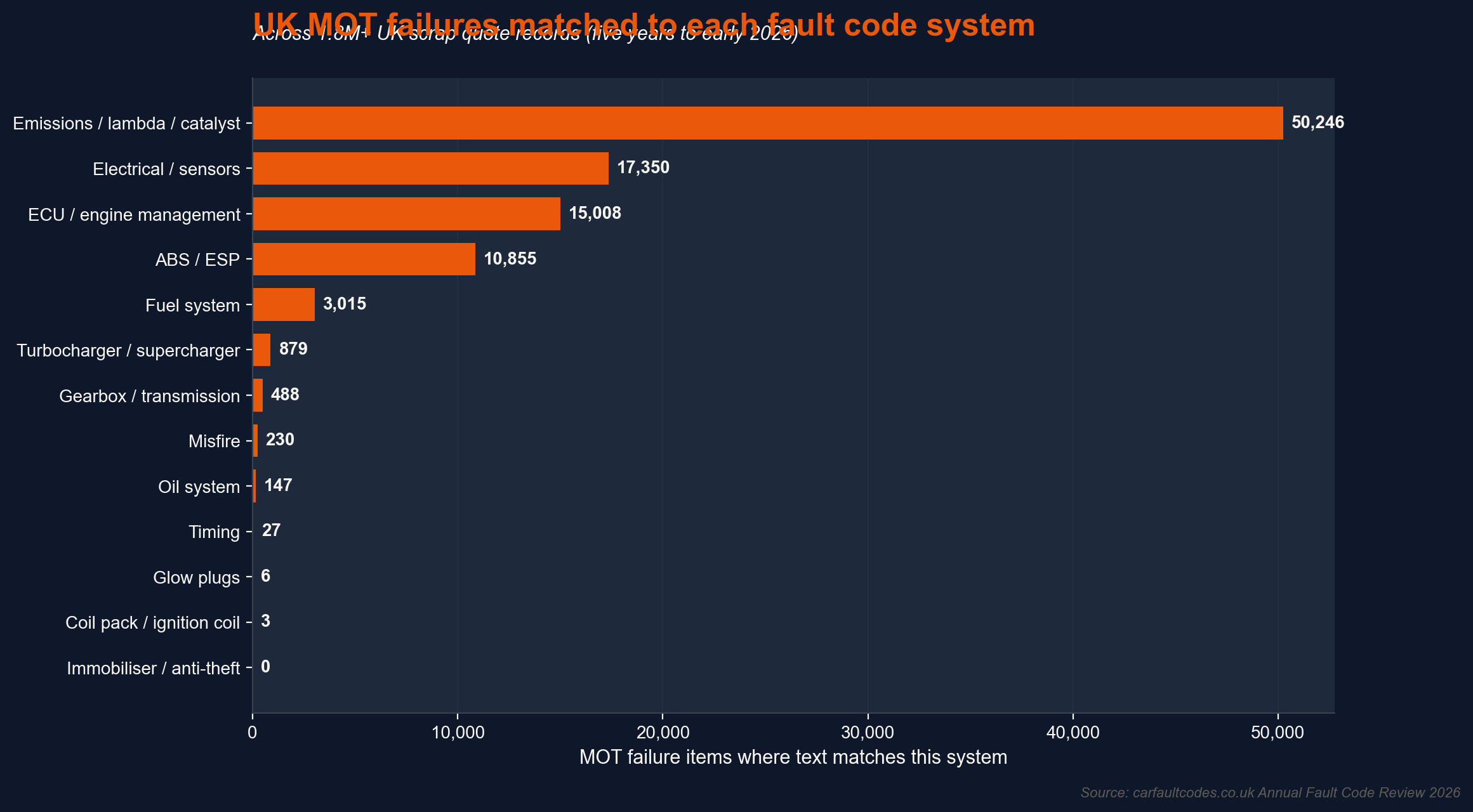
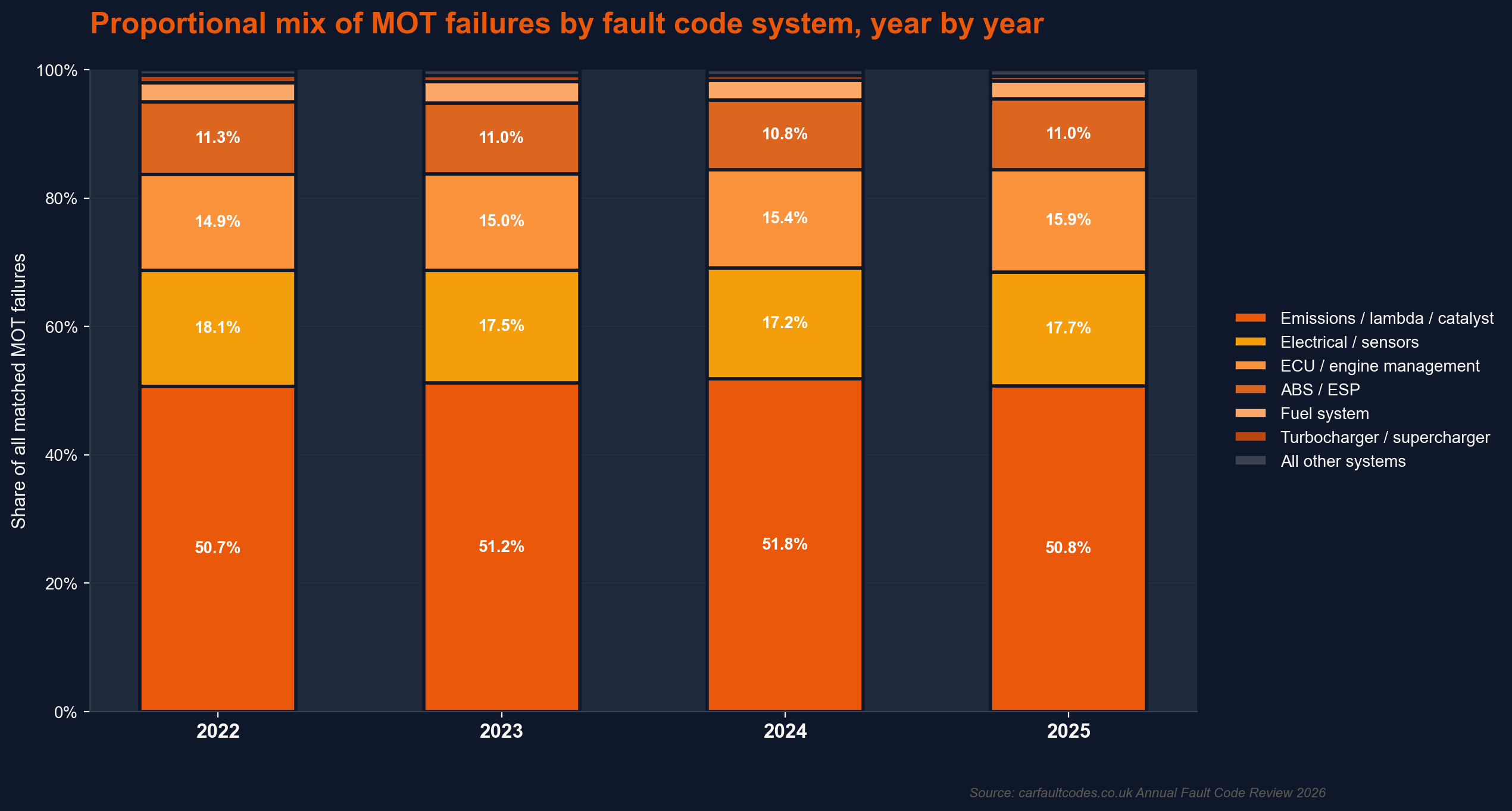
The monster. Emissions holds more failure items than every other system combined, yet its lift is one of the lowest on the board. Read those two facts together and you get the story of this whole report: most emissions failures arrive with no advisory and no warning. The cat or lambda sensor dies quietly, and the first anyone hears about it is the fail sheet.
In plain English
Emissions codes cover the lambda (oxygen) sensors that measure the exhaust, the catalytic converter that cleans it, and the various valves and pipes that recirculate or trap unburnt fumes. This is the area where the MOT gets most directly involved.
What you might notice as a driver
Engine warning light on, often with no obvious change in how the car runs. A failed MOT emissions test. A slight loss of power. A smell of fuel. On diesels: visible black smoke under acceleration that did not used to be there.
Common causes
A failed lambda sensor — by some distance the most common emissions code cause. A worn catalytic converter (often as a result of a previous misfire). EGR valve stuck open or closed. A loose petrol cap (yes, really, this triggers P0455 and P0457). Diesel-specific: blocked DPF, EGR cooler failure, AdBlue system faults on newer cars.
What to do about it
On a petrol, check the fuel cap is on tight first. It costs nothing to do and clears a surprising number of warning lights. Otherwise, an emissions warning is not urgent in the safety sense, but it will fail the MOT and is unlikely to fix itself.
Mechanic-grade notes
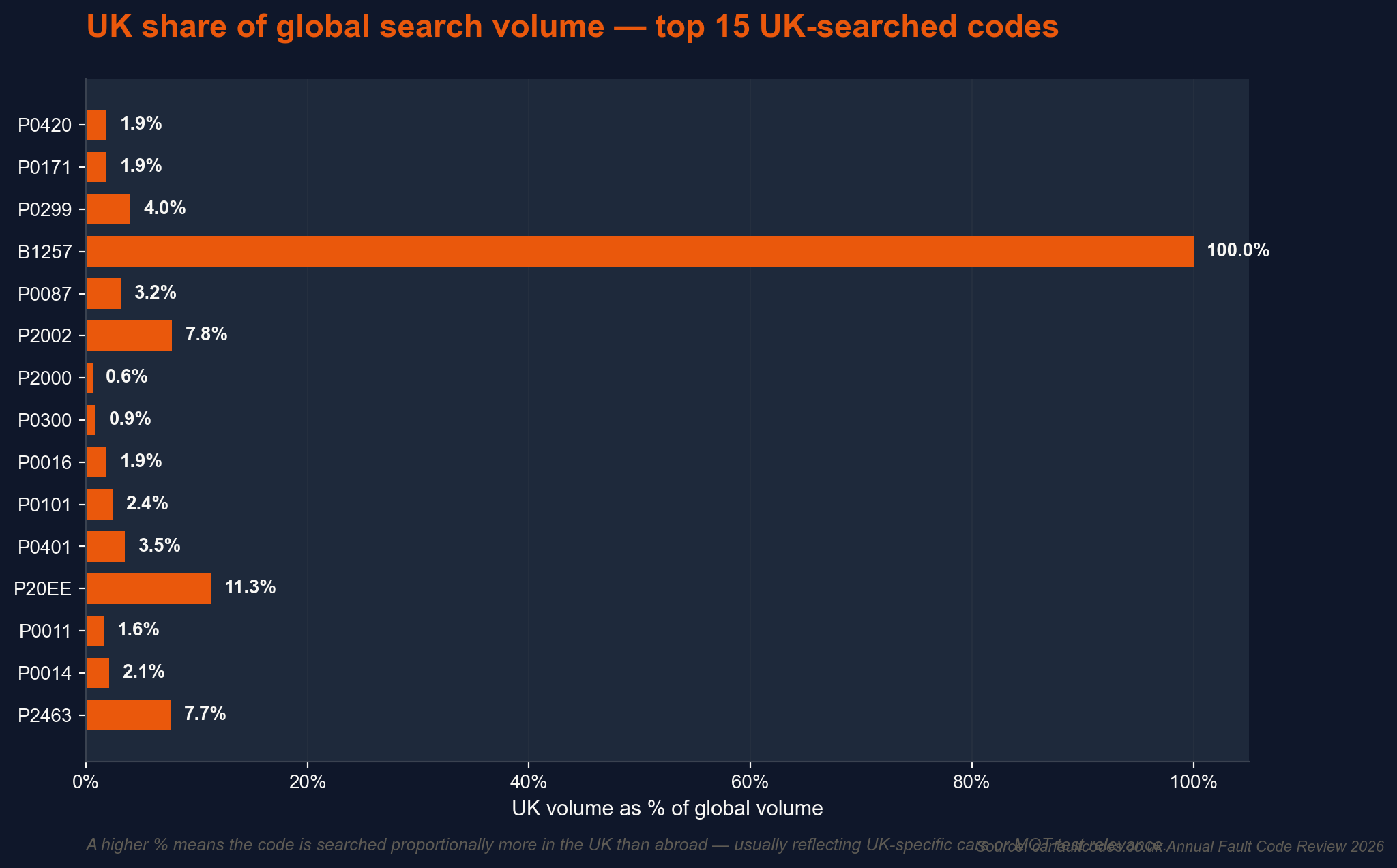
P0420 (catalyst efficiency) is the most-searched fault code in the UK at 2,100 monthly searches. Genuine cat replacement is expensive (£500-£2,000 for a quality unit on most cars). Aftermarket cheap cats often fail emissions and re-trigger the code within months. Always read freeze-frame data: was the engine in closed loop? Was fuel trim sensible? Many "cat failed" diagnoses are actually upstream: a failing lambda sensor, an exhaust leak before the cat, or an unburnt fuel issue.
MOT relevance
The MOT directly measures lambda and exhaust gas composition. Emissions issues are the largest single bucket of MOT failures we measured: 50,246 failure items across 1.8M+ UK vehicles.
The fault codes in this system
| Total codes | 258 |
| Generic SAE codes | 113 |
| Manufacturer-specific | 145 |
| Code letter mix | P: 251, U: 7 |
How this system shows up in MOT data
| MOT failure items matched | 50,246 |
| MOT advisory items matched | 3,159 |
| Vehicles with ≥1 advisory | 3,129 |
| Vehicles with ≥1 failure | 35,043 |
When an advisory is present, the next MOT
vs UK base of 7.18%
2.1× lift
Top MOT failure descriptions (verbatim)
| ~10,700 | Exhaust Lambda reading after 2nd fast idle outside specified limits |
| ~5,800 | Exhaust carbon monoxide content after 2nd fast idle exceeds manufacturer's specified limits |
| ~3,300 | Exhaust carbon monoxide content after 2nd fast idle exceeds default limits |
| ~3,200 | Exhaust emissions exceed manufacturer's specified limit |
| ~2,900 | Emissions unable to be completed |
| ~2,600 | Exhaust carbon monoxide content at idle exceeds manufacturer's specified limits |
Top MOT advisory descriptions (verbatim)
| 50 | emissions too clean |
| 27 | dpf light flashing |
| 25 | emissions not detected |
| 23 | DPF light on |
| 14 | emissions too clean to register |
| 14 | emissions to clean to pick up |
Turbocharger / supercharger
A boost fault rarely fails an MOT by itself. What it does is drop a diesel into limp mode halfway up the M6. I'd fix a sticking turbo long before the test forced my hand.
In plain English
A turbocharger uses your exhaust gases to spin a compressor that forces extra air into the engine. It gives a small engine the punch of a bigger one. Most modern diesels and many modern petrols are turbocharged.
What you might notice as a driver
Loss of power, particularly noticeable when overtaking or going up hills. A whistle or whine from the engine bay that grows louder over weeks. Excessive smoke under acceleration: blue smoke means oil getting past worn turbo seals, black smoke means too much fuel for the air available.
Common causes
Worn turbo bearings, often from poor oil maintenance (turbos hate dirty oil and short trips that never let the oil reach proper temperature). A stuck wastegate or variable-vane mechanism on diesels. A failed boost pressure sensor. A split intercooler hose. A failed electronic actuator.
What to do about it
Limp mode from a turbo fault means reduced power and an engine warning light. The car will get you home but not at speed. Do not drive on for weeks — turbo failures can let metal into the oil supply, which kills the engine.
Mechanic-grade notes
P0299 (turbo underboost) is the second-most-searched UK fault code with 1,200 monthly searches. Ford EcoBoost 1.0 and PSA 1.6 HDi have well-known turbo issues. Get a known-good actuator before condemning the whole turbo. On VAG TDI engines, check the variable vane mechanism for soot build-up before considering replacement. Always replace the oil feed pipe with a new turbo, and prime the turbo with oil before first start.
MOT relevance
Turbo issues show up in MOT data primarily as smoke failures: 608 cases of "exhaust emissions exceed level of metered smoke for a turbo charged engine".
The fault codes in this system
| Total codes | 141 |
| Generic SAE codes | 72 |
| Manufacturer-specific | 69 |
| Code letter mix | P: 141 |
How this system shows up in MOT data
| MOT failure items matched | 879 |
| MOT advisory items matched | 684 |
| Vehicles with ≥1 advisory | 679 |
| Vehicles with ≥1 failure | 871 |
When an advisory is present, the next MOT
vs UK base of 7.18%
2.38× lift
Top MOT failure descriptions (verbatim)
| ~610 | Exhaust emissions exceed level of metered smoke for a turbo charged engine |
| ~100 | Exhaust emissions exceed level of metered smoke for a non-turbo charged engine |
| 43 | Exhaust emits an excessive level of metered smoke for a turbo charged engine (7.4.B.3b) |
| 10 | Exhaust emits an excessive level of metered smoke for a non-turbo charged engine (7.4.B.3b) |
| 2 | Exhaust emissions exceed level of metered smoke for a non-turbo charged engine limit 0.7 value on emissions 1.51 |
| 2 | Exhaust fumes causing a danger to health of persons on board leaking around turbo area |
Top MOT advisory descriptions (verbatim)
| 24 | Oil leak, but not excessive turbo |
| 22 | Oil leak, but not excessive turbo area |
| 14 | Exhaust has a minor leak of exhaust gases turbo area |
| 14 | Oil leak, but not excessive from turbo |
| 11 | Exhaust has a minor leak of exhaust gases turbo |
| 8 | Front Exhaust has a minor leak of exhaust gases Turbo Area |
Timing (camshaft / crankshaft / belt / chain)
27 failures, the smallest count on the board, and the most misleading number in it. Timing faults don't fail MOTs. They write off engines. The test is simply not where this system does its damage.
In plain English
Engine timing keeps the valves and pistons working in sync. Most cars use either a rubber timing belt that needs replacing every 60-100k miles, or a metal timing chain that is supposed to last the engine's life. Fault codes in this section come from the sensors that watch the timing components doing their job.
What you might notice as a driver
A rattle on cold start, especially on a chain-driven engine. Rough running. The engine refusing to start after a parts replacement (timing slipped). A flashing engine warning light. In a worst case, the engine going dead with a metallic noise (timing belt gone, valves and pistons collide).
Common causes
Failed camshaft or crankshaft position sensors (cheap fix). A stretched timing chain — common on certain VAG 1.4 TSI, BMW N47/N20, Mini, and Ford 1.0 EcoBoost engines. A timing belt that has gone past its replacement interval. A failed VVT (variable valve timing) actuator.
What to do about it
A rattle on cold start that is new is a serious warning sign. Get it scanned immediately. A timing chain that has been rattling for months on a known-bad engine (BMW N47 is the famous one) can break catastrophically. The repair bill on a snapped timing chain or belt is usually £2,000+ on most modern cars; on some, the engine is a write-off.
Mechanic-grade notes
P0011-P0017 family covers cam/crank correlation. Always check oil level and condition first. VVT actuators run on oil pressure, and dirty thick oil from missed services is a top cause of these codes. On chain failures, do not just replace the chain: replace the tensioner, guides and sprockets as a kit. On BMW N47, do the chain at the first hint and do it with the engine out. Doing it in situ is harder and tends to come back.
MOT relevance
Timing faults are not directly MOT-checked. They show up indirectly when a worn timing system causes an emissions failure or warning light. 392 advisory items in our data mention "timing chain noisy" — drivers on the way to a much bigger bill.
The fault codes in this system
| Total codes | 160 |
| Generic SAE codes | 121 |
| Manufacturer-specific | 39 |
| Code letter mix | P: 160 |
| UK monthly search volume | 4,220 |
| Global monthly search volume | 365,060 |
How this system shows up in MOT data
| MOT failure items matched | 27 |
| MOT advisory items matched | 392 |
| Vehicles with ≥1 advisory | 391 |
| Vehicles with ≥1 failure | 27 |
When an advisory is present, the next MOT
vs UK base of 7.18%
2.67× lift
Most-searched codes in this system
| Code | What it means | Generic? | UK / mo | Global / mo |
| P0016 | Crankshaft Position - Camshaft Position Correlation (Bank 1 Sensor A) | Yes | 600 | 32,000 |
| P0011 | "A" Camshaft Position - Timing Over-Advanced or System Performance (Bank 1) | Yes | 500 | 31,000 |
| P0014 | "B" Camshaft Position - Timing Over-Advanced or System Performance (Bank 1) | Yes | 500 | 24,000 |
| P0340 | Camshaft Position Sensor "A" Circuit Malfunction | Yes | 350 | 42,000 |
| P0017 | Crankshaft Position - Camshaft Position Correlation (Bank 1 Sensor B) | Yes | 300 | 18,000 |
| P0335 | Crankshaft Position Sensor A Circuit Malfunction | Yes | 250 | 38,000 |
| P0341 | Camshaft Position Sensor "A" Circuit Range/Performance | Yes | 250 | 11,000 |
| P0500 | Timing Belt Skipped One Tooth Or More | Yes | 150 | 21,000 |
Top MOT failure descriptions (verbatim)
| 2 | Emissions not tested timing belt overdue |
| 2 | Emissions unable to be completed engine oil low and engine timing chain noisy,advise oil and filter may help with chain noise |
| 2 | Emissions unable to be completed engine noisey/timing chain area |
| 1 | Emissions not tested Possibly overdue for timing belt |
| 1 | Emissions not tested unsure of condition of timing belt |
| 1 | Emissions not tested engine stopped possible timing chain broken (7.3.A.1) |
Top MOT advisory descriptions (verbatim)
| 41 | timing chain noisy |
| 9 | timing belt history ? |
| 9 | timing chain noisey |
| 9 | Has this vehicle had the timing belt replaced? |
| 7 | engine timing chain noisy |
| 7 | timing chain very noisy |
ECU / engine management (the dashboard MIL)
An illuminated engine light is the single most reliable predictor of failure in this entire report. One car in five carrying that advisory fails its next test. Nothing else on the dashboard comes close.
In plain English
The ECU (Engine Control Unit) is the main computer running your engine. The MIL — Malfunction Indicator Lamp, more commonly called the engine warning light or check engine light — is controlled by the ECU. When this light comes on, the ECU has logged at least one fault code, somewhere on the car.
What you might notice as a driver
The orange engine-shape symbol on your dashboard. Solid means an ongoing fault that needs investigating. Flashing means an active fault, usually a misfire, that needs investigating now.
Common causes
Hundreds of possible causes — that is exactly why fault code reading exists. The ECU does not tell you the problem from the dashboard; it tells you from the OBD port. It might be a £5 fuel cap or a £2,000 catalytic converter. The only way to know is to read the codes.
What to do about it
Solid engine warning light: book a diagnostic scan when convenient. The car is fine to drive in the meantime, but the issue will not fix itself. Flashing engine warning light: drive gently, get to a garage today.
Mechanic-grade notes
Always pull all codes from all modules, not just the engine module. A "check engine" light can be triggered by a TPMS code, a body code, a chassis code or anything else that escalates to the cluster. Read freeze-frame data with the active code: engine speed, coolant temperature, fuel trim. They are often more useful than the code itself.
MOT relevance
The MOT explicitly checks whether the engine MIL is functioning correctly and whether it is currently indicating a fault. If the MIL is on at MOT time, the car fails. Our data shows 14,319 MOT failures from this single failure mode, the biggest direct dashboard-to-MOT linkage in the UK.
The fault codes in this system
| Total codes | 1,108 |
| Generic SAE codes | 197 |
| Manufacturer-specific | 911 |
| Code letter mix | B: 325, C: 59, P: 387, U: 337 |
How this system shows up in MOT data
| MOT failure items matched | 15,008 |
| MOT advisory items matched | 423 |
| Vehicles with ≥1 advisory | 423 |
| Vehicles with ≥1 failure | 14,962 |
When an advisory is present, the next MOT
vs UK base of 7.18%
2.93× lift
Top MOT failure descriptions (verbatim)
| ~14,300 | Engine MIL inoperative or indicates a malfunction |
| ~130 | Front Engine MIL inoperative or indicates a malfunction |
| 27 | Engine MIL inoperative or indicates a malfunction inoperative |
| 22 | Central Front Engine MIL inoperative or indicates a malfunction |
| 20 | Offside Front Engine MIL inoperative or indicates a malfunction |
| 16 | Engine MIL inoperative or indicates a malfunction eml on |
Top MOT advisory descriptions (verbatim)
| 53 | Engine MIL inoperative or indicates a malfunction |
| 33 | engine mil light on |
| 30 | Engine MIL indicates a malfunction |
| 17 | engine mil on |
| 15 | engine mil lamp on |
| 13 | Engine MIL inoperative |
Immobiliser / anti-theft
Ignore the 6.97x at the top of the lift chart. It comes from a sample of two cars. Two. It stays in the tables because hiding awkward rows is how reports lose trust, but nobody should base a decision on it.
In plain English
The immobiliser is your car's electronic anti-theft system. It stops the engine starting unless the correct key is detected. Modern keys carry a small transponder chip; the car has a reader coil round the ignition or in the ignition switch.
What you might notice as a driver
A red key or padlock symbol on the dashboard that should go out within seconds of unlocking. The car cranking but not firing. The starter motor refusing to turn. Sometimes intermittent: fine for weeks, then refuses to start for an afternoon.
Common causes
A failing transponder chip in the key (usually after physical damage to the key). A failed reader coil round the ignition. A failed body control module. A flat 12V battery causing memory loss in some systems (Mercedes is famous for this).
What to do about it
Immobiliser faults are often intermittent. If your spare key works, the master key is the problem. If neither key works, the issue is on the car side. Genuine immobiliser repairs need a main dealer or an auto-electrician with the right kit. DIY is not realistic on most modern cars.
Mechanic-grade notes
P1660-P1665, B1905-B1906 and similar. Always start with a key check using known-good batteries. Reader coil resistance test before module replacement. Some cars (older Ford, VAG) need PIN extraction and module recoding; others (BMW, Mercedes) need dealer-level access. Aftermarket programmers cover most of the volume range these days.
MOT relevance
Immobiliser faults rarely show up in MOT data because immobilised cars do not start. They never make it to the test bay. Drivers experience them as failed-to-proceed events.
The fault codes in this system
| Total codes | 64 |
| Generic SAE codes | 3 |
| Manufacturer-specific | 61 |
| Code letter mix | B: 37, P: 23, U: 4 |
How this system shows up in MOT data
| MOT failure items matched | 0 |
| MOT advisory items matched | 2 |
| Vehicles with ≥1 advisory | 2 |
| Vehicles with ≥1 failure | 0 |
When an advisory is present, the next MOT
vs UK base of 7.18%
6.97× lift
Top MOT advisory descriptions (verbatim)
| 1 | car has some electric or immobiliser problem |
| 1 | Steering lock not functioning steering lock not working, vehicle has an engine immobiliser chip in the ignition key |
Electrical / sensors (broadest category)
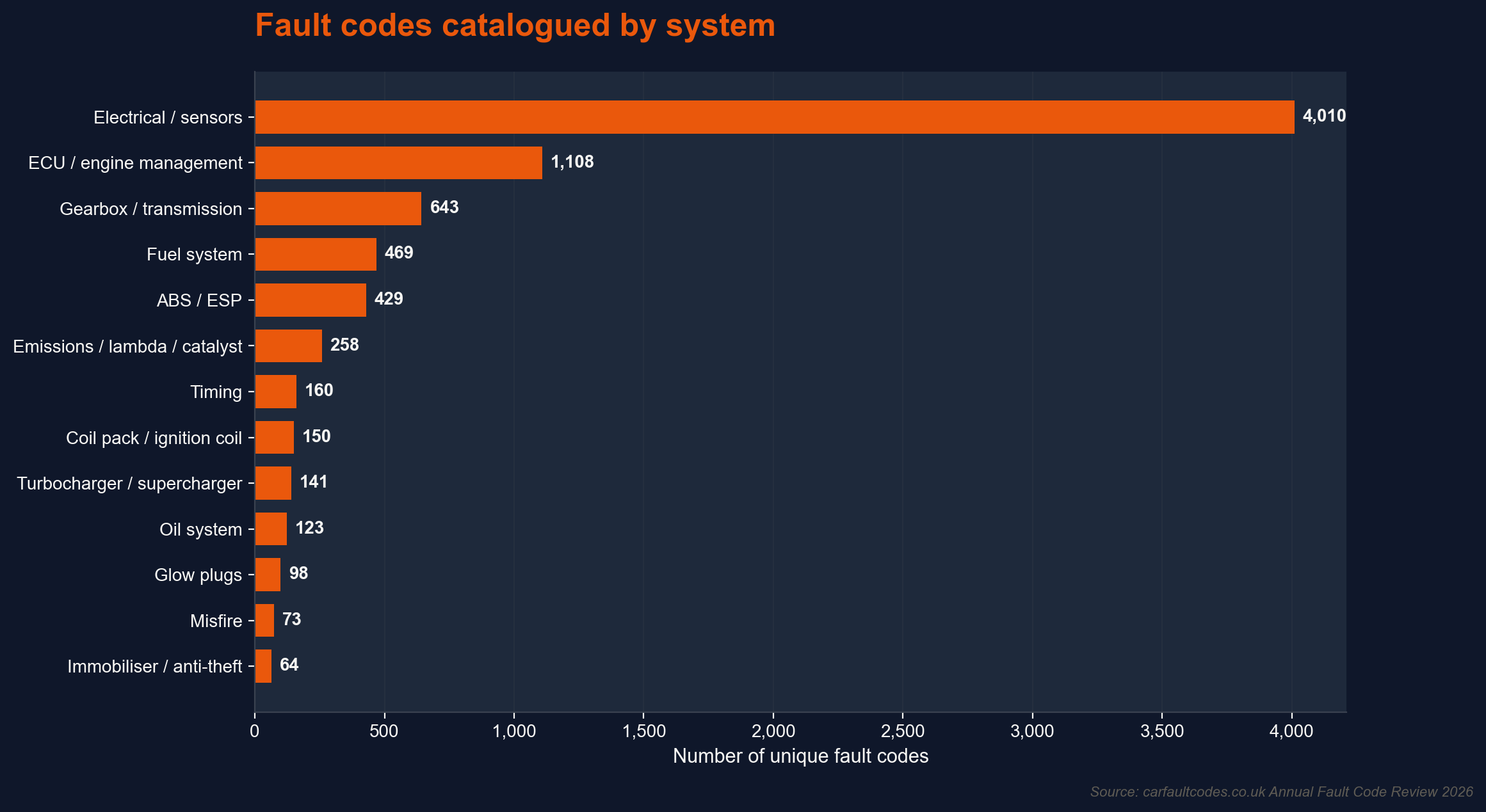
More than half the library lives here, 4,010 codes, and that's the point. Modern cars fail electrically long before they fail mechanically. When a scanner throws up something obscure, the odds say it belongs in this bucket.
In plain English
This is the catch-all for electrical and sensor codes. Every system on a modern car has electronic sensors monitoring it, and any of them can fail or have a wiring issue. Hence the size: over half of all fault codes sit in this category.
What you might notice as a driver
Almost any dashboard warning light not covered by the other categories. The airbag warning. The brake fluid warning. The traction control light. The tyre pressure monitoring system. Parking sensors going wrong. Climate control playing up. Lighting issues. Intermittent gremlins.
Common causes
Individual sensor failures (always cheaper to swap than a module). Damaged wiring, especially in the engine bay where heat and vibration take a toll. Corroded connectors, particularly common on older cars near the battery and on door multiplugs. Water ingress to electrical modules. A failed module itself.
What to do about it
A warning light from this category is usually not safety-critical, but it will cost you an MOT pass if it is on at the test. The airbag and brake fluid warning are the two big direct MOT failures. The others vary.
Mechanic-grade notes
Always start with battery health and charging voltage on any car with multiple unrelated electrical codes. A dying battery throws codes from every module on the bus. Diagnose the wiring before condemning a module: a £1,200 BCM is rarely the actual culprit when a £30 connector is corroded ten centimetres away.
MOT relevance
The airbag (SRS) warning lamp accounts for 5,608 MOT failures in our data. The brake fluid warning, a small advisory, is the single strongest predictor of MOT failure in our dataset, with vehicles carrying it being 9.76× more likely to fail their next MOT.
The fault codes in this system
| Total codes | 4,010 |
| Generic SAE codes | 1,056 |
| Manufacturer-specific | 2,954 |
| Code letter mix | B: 1351, C: 273, P: 2248, U: 138 |
| UK monthly search volume | 12,670 |
| Global monthly search volume | 894,640 |
How this system shows up in MOT data
| MOT failure items matched | 17,350 |
| MOT advisory items matched | 7,907 |
| Vehicles with ≥1 advisory | 7,614 |
| Vehicles with ≥1 failure | 14,826 |
When an advisory is present, the next MOT
vs UK base of 7.18%
2.96× lift
Most-searched codes in this system
| Code | What it means | Generic? | UK / mo | Global / mo |
| B1257 | Air Temperature External Sensor Circuit Short To Ground | No | 1,000 | 1,000 |
| P0113 | Intake Air Temperature Sensor 1 Circuit High Input | Yes | 450 | 50,000 |
| P0135 | Oxygen O2 Sensor Heater Circuit Malfunction (Bank 1, Sensor 1) | Yes | 250 | 23,000 |
| P0141 | O2 Sensor Heater Circuit Malfunction (Bank 1, Sensor 2) | Yes | 250 | 19,000 |
| P0030 | HO2S Heater Control Circuit (Bank 1 Sensor 1) | Yes | 250 | 14,000 |
| P1100 | O2 Sensor Circuit (Bank 1-Sensor 2) Heating Circuit Voltage Too Low | No | 250 | 5,100 |
| P2015 | Intake Manifold Runner Position Sensor / Switch Circuit Range/Performance Bank 1 | No | 250 | 4,100 |
| P11DB | NOx Sensor 1 Current Performance | No | 250 | 600 |
Top MOT failure descriptions (verbatim)
| ~6,600 | Anti-lock braking system warning lamp indicates an ABS fault |
| ~5,600 | Supplementary restraint system warning lamp indicates a fault |
| ~2,500 | Electronic stability control warning lamp indicates a fault |
| ~370 | Electronic power steering warning lamp indicates a system malfunction |
| ~320 | Anti-lock braking system warning lamp does not illuminate |
| ~160 | Hazard warning lamps inoperative |
Top MOT advisory descriptions (verbatim)
| ~2,800 | Supplementary restraint system warning lamp does not illuminate |
| ~970 | Brake fluid warning lamp illuminated |
| ~180 | Electronic stability control warning lamp not working |
| ~140 | Trailer electrical socket insecure |
| 75 | Supplementary Restraint System warning lamp does not illuminate |
| 61 | Front Supplementary restraint system warning lamp does not illuminate |